

When goals are written with ‘weasel words’, and most goals are, they are misunderstood and immeasurable, and consequently not achieved.
Most leaders struggle with measuring what matters, but continue to use the same broken methods to measure their strategic goals. They want data to drive decisions, but don’t realise that excellent metrics start with how goals are articulated, not with what data is available.
Meaningful measures quantify the observable evidence of the impacts implied by our goals. If our goals are not clearly articulated, the impacts are elusive, the evidence remains invisible, and the right measures are impossible to identify.
Our goals are too often written in vague “corporate speak” that we call weasel words. Goals like this are impossible to measure, until the weasel word problem is fixed.
What are weasel words?
Weasel words are words that have no specific, obvious and singular meaning – they can mean different things to different people in different contexts. When we use weasel words in our goals, they have a stupefying effect on people’s understanding of those goals, as well as rendering those goals immeasurable.
Weasel words are easy to recognise once you get a taste:
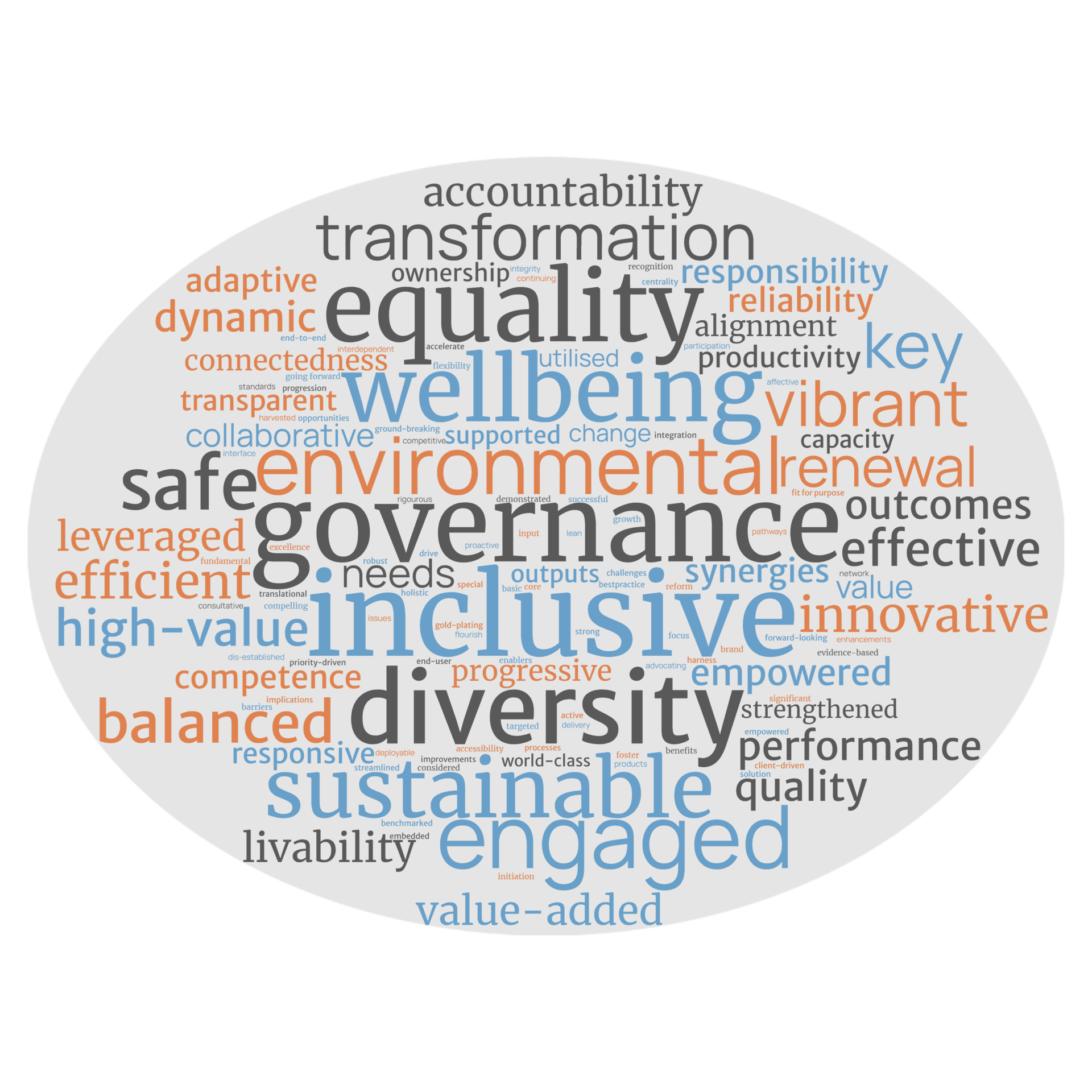
…accelerate, accessibility, accountability, active, adaptive, advocating, affective, alignment, balanced, barriers, basic, benchmarked, benefits, best practice, brand (image), capacity, centrality, challenges, change, client-driven, collaborative, compelling, competence, competitive, connectedness, considered, consultative, continuing, core, delivery, demonstrated, deployable, dis-established, diversity, drive, dynamic, effective, efficient, embedded, empowered, enablers, end-to-end, end-user, evidence-based, focus, foster, empowered, engaged, enhancements, excellence, fit for purpose, flexibility, flourish, forward-looking, fundamental, going forward, gold-plating, governance, ground-breaking, growth, harness, harvested, high-value, holistic, implications, improvements, inclusive, initiation, innovative, input, integration, integrity, interdependent, interface, issues, key, lean, leveraged, livability, mandated, needs, network, opportunities, optimised, outcomes, outputs, oversighting, ownership, pathways, participation, performance, priority-driven, proactive, processes, productivity, products, progression, progressive, quality, reanimate, recognition, re-engerise, reform, reliability, renewal, responsibility, responsive, rich, rigourous, roadmap, robust, significant, solution, special, standards, strategically, streamlined, strengthened, strong, successful, supported, sustainable, synergies, targeted, transformation, translational, transparent, underpinning, uniqueness, utilised, value, value-added, vanilla solutions, vibrant, wellbeing, winning, world-class, zoomify…
Weasel words are empty and inert words that sound important and fail to say to anything at all, or at least speak of anything that can be verified in the real world. Or measured.
Why are they called weasel words?
Wikipedia explains where the ‘weasel word’ term originated:
[A] weasel word… is a word or phrase aimed at creating an impression that something specific and meaningful has been said, when in fact only a vague, ambiguous, or irrelevant claim has been communicated… The expression weasel word may have derived from the egg-eating habits of weasels… The expression first appeared in Stewart Chaplin’s short story ‘Stained Glass Political Platform’ (published in 1900 in The Century Magazine), in which they were described as “words that suck the life out of the words next to them, just as a weasel sucks the egg and leaves the shell.”
Wikipedia: Weasel word
PuMP has included the term ever since its creator was inspirated by Don Watson, an Australian political speech writer and author of many books but two in particular to do with weasel words: “Death Sentence: The Decay of Public Language” and “Watson’s Dictionary of Weasel Words“. The removal of weasel words from goals, prior to measurement, is a unique and fundamental feature of PuMP, and a key to why it works.
Regardless of the origins of the term “weasel word”, the impact of weasely language in our goals is profoundly constraining in our ability to measure our strategy well enough to convince us of its execution and achievement.
Why are weasely goals such a problem?
If your goals (or objectives or outcomes) are written with weasel words, you will struggle to find meaningful measures, you won’t realise that the measures you have aren’t meaningful, and you’ll wonder why people aren’t engaged in achieving those goals.
Goals written with weasel words are in almost every organisation. The following examples were quickly sampled from the first few pages of Google search results for the terms ‘strategic plan’ and ‘corporate plan’. The weasel words are italicised.
- “Embolden our focus on learning and teaching excellence.”
– from a university - “Develop, implement and evaluate innovative ways of enhancing our value to clients and stakeholders”
– from a native title tribunal - “Ensure open and transparent processes and consistent approaches to decision-making”
– from the same native title tribunal - “The Society will leverage existing special events to develop partnerships with participating organisations”
– from a not-for-profit charity - “We will inspire and empower our community to be active lifelong learners by creating, promoting, advocating and connecting people to diverse and rich learning opportunities.”
– from a council library - “Drive, at a State and national level, the development of an innovative, flexible and responsive training sector”
– from a government department of training and workforce development - “Maintain integrity, accountability, transparency and quality in the governance, performance and reporting of our activities.”
– from the same government department of training and workforce development - “Advocating for evidence-based policy reform”
– from a cancer council - “To represent and lead the AOD sector at a national level by promoting effective policies, strategies and approaches that address AOD related harm”
– from an alcohol and drugs council - “A strong, effective and sustainable organization, providing excellence and innovation in custodianship of the community’s resources”
– from a local government organisation - “To deliver high quality and consistent services.”
– from an aged care organisation - “Attracting and serving a diverse and inclusive membership worldwide…”
– from a physics society - “Sustainable development of mining industry”
– from an economic development agency - “[Provide] inclusive mental health and well-being programs and services that are evidence-based, culturally sensitive and responsive to individuals, communities and service providers.”
– from a mental health care provider - “Building community capacity and expanding our sphere of influence to achieve better outcomes”
– from a disability support organisation - “Intensifying customer engagement and ensuring progress works in harmony with heritage values.”
– from a cultural entertainment venue - “Develop a skilled, engaged and healthy workforce.”
– from a bus company
Reflect on this list again:
- What do you think they mean?
- How would you explain them to someone else?
- How would you prove they were achieved?
- How would you measure them?
How to fix the weasel word problem…
To measure weasely goals like those above, we have to replace, or at the very least explain, the weasel words.
We replace weasel words with words that more directly or specifically describe what we would observe in the real world if that goal was actually achieved. If we can’t replace them (the “our plan is already cast in stone” situation), then we have to at least translate or define them.
If we can’t recognise, in the real world, what would be different or better as direct evidence that our goal has been achieved, then we don’t have a goal at all.
Why aim for a change we know we won’t recognise if it happens or not?
Try this:
Read over your strategic, operational or business plan and highlight all the weasel words in the goals or objectives. How can you express what those words are really trying to say, in words that make it easier to understand and measure the results they imply?
Here are three tips for how to de-weasel your goals:
- Write down everyone’s answer to the question “what does this mean?” If those answers have more weasel words in them, ask the question again. And again. And again. Until you don’t have any weasel words left.
- Explain your goals to a 10-year old until they can rearticulate those goals in their own words. Maybe their words are the best words to use?
- List examples of what those weasel words are trying to describe. Detailed and specific examples. Even if you have dozens of them. Which examples best describe the result implied by your weasely goal? Rewrite the goal more closely based on the words from those best examples.
De-weaseling your goals is the single best thing you can do to find measures that are sensible and useful in achieving those goals. It’s the single best thing you can do to make your strategic direction understandable to those who will execute it. Therefore, it’s the single best thing you can do to achieve your strategic direction.
In PuMP, we deal with the weasel words before we start to talk about measures. This always creates unexpected clarity and speed in choosing measures that can directly evidence the results that matter. It takes a few hours longer to do this, but saves years of wasted effort and resources failing to achieve those weasely goals.