

Why strategy execution drifts — and how the Results Map creates organisation-wide alignment that brings every team back onto the same page.

Even when organisations have a well-documented strategy, alignment across teams can be surprisingly fragile. Beautifully designed strategy documents are shared through leadership announcements, town halls, emails, and team meetings. Everyone takes it on board. But then, slowly, without anyone intending it, strategy execution begins to drift. It drifts because everyone has internally interpreted the strategy in their own way — filtered through their own priorities, their own language, and the pressures they face day to day.
Solving the strategy alignment problem requires that we go deeper — rethinking the words we use to articulate strategic goals, the way those goals are measured, and the logic adopted to help every team choose their own goals and measures that align to execute and achieve the real strategic direction.
Why strategy execution drifts even when the strategy is well-documented
It’s often the elephant in the room: a beautifully documented strategy that simply hasn’t created shared understanding of the organisation’s direction.
This same strategy document is read by fifty different people and produces fifty slightly different pictures of what we’re here to do. Each team interprets the strategy through the lens of what they already know and do. There’s no way around it when the strategy is written in typical strategic language. And strategic drift is the inevitable consequence.
No-one wants to admit they don’t understand the strategy. So most leaders remain oblivious to this problem, unaware of it until it becomes visible and already costly to fix. Then they look for reasons behind the misalignment and disengagement in all the wrong places, like communication or culture. But the real reasons are found right at the beginning of the strategy process, and it costs nothing to fix them.
Strategic alignment that leads to strategy achievement is built on a foundation of three basic steps:
- Goal clarity — but the kind of clarity many leaders have never been taught to create
- Measurable evidence — that brings a real-world tangibility to the goals to be achieved
- Cause-effect logic — to build strategic alignment based on the best contributions each team can make to achieving the strategy
Try this:
Think about a strategic goal in your organisation. Now imagine ten different team leaders reading that goal independently. How many different lists of planned initiatives would you get? If the answer is likely “many,” that’s a signal that the goal is written in a way that invites divergence rather than convergence.
Step 1: Rewrite strategic goals as clear results, not actions
To make this concrete, let’s use a fictional organisation called CaCAO — Chocolate and Cocoa Apothecary Operations — which researches, develops, manufactures, and sells medicinal chocolate products.
Here are three of their strategic goals:
- Establish a suite of evidence-based medicinal chocolate products with demonstrable impact.
- Foster a collaborative, diversified and engaged workplace.
- Change community attitudes to chocolate.
Each of these goals is entirely reasonable. Each sounds strategically important. And each one, if you put it in front of department heads, team managers and employees, it will generate a different mental picture of what to do next for each person who reads it.
That’s because these goals are written as broad actions or as vague aspirations — not as specific results. And a strategy written as actions or vague words is a strategy that breeds divergence.
When the Advocacy and Sales team at CaCAO read “Change community attitudes to chocolate,” they might plan awareness campaigns, a social media content series, influencer partnerships, media outreach, community events, and educational webinars. All reasonable. All arguably “related to the strategy.” But none of them necessarily pointing in the same direction.
This is the root of the problem. And it’s the place we need to fix first.
Alignment becomes stronger when it’s built around results.
Alignment to strategy is really about each team understanding what they most need to achieve — before they decide what they need to do.
There’s a critical distinction that too many organisations never notice. Activity-focused alignment — “we’re all doing things related to the strategy” — feels like alignment, but it isn’t. Activities keep teams busy. Results give teams something concrete to contribute to, and something concrete to check whether they’re on track.
When you rewrite strategic goals as clear results, two important shifts happen. Firstly, the goals become anchored in the real world where teams are actually working, so they are easier to understand, and far easier to align to. And secondly, those goals will become easier to measure in a meaningful way.
Here’s what CaCAO’s goals look like reframed as clear, specific and measurable results:
| Original goal (action/aspiration) | Reframed as a result |
|---|---|
| Establish a suite of evidence-based medicinal chocolate products with demonstrable impact | Our medicinal chocolate products do exactly what the labels promise |
| Foster a collaborative, diversified and engaged workplace | Teams reach their goals without manager intervention [for ‘collaborative’] |
| Change community attitudes to chocolate | The market for MCPs readily pays what they are really worth |
Notice the difference: the reframed results describe the world as it needs to be — not what teams need to do. That makes it much clearer which team contributes to which goal, and what “success” actually looks like. And only after teams are clear about this, can they choose actions that will have the best chance of creating that success.
And for CaCAO’s Advocacy and Sales department, they can align their own team and department contributions to the strategic results more easily:
- At the strategic level: Advocacy and Sales see their most important contribution is to the strategic result of “The market for MCPs readily pays what they are really worth.”
- At the department level: the whole of Advocacy and Sales contributes to this strategic goal by focusing on the results of “Demand for MCPs grows steadily” and “Our followers are promoters of our message.”
- At the team level: teams within Advocacy and Sales choose results like “The world is fascinated by the story of chocolate’s potency,” “Practitioners understand the value of MCPs,” and “The world’s chocolate appreciators become our followers” to contribute to the department results.
Shortly we’ll see how a Results Map will pull together a visual story of an entire organisation’s alignment to strategy, but here we have CaCAO’s Advocacy and Sales’ part of the story:

This is a mindset shift, from activity-based alignment to result-based alignment. It requires slowing down before you execute, taking time to decide and define the results that every activity should be chosen to achieve. The clarity you gain by slowing down pays dividends throughout the entire strategy execution process.
Try this:
Take one strategic goal from your organisation and ask: “What would the world look like if this goal were truly achieved?” Write that as a single sentence in the present tense — as if success has already happened. That’s your result. In PuMP, we call this type of goal grammar a “future fact“.
Step 2: Use KPIs as evidence of results, not proof of effort
Once you’ve defined clear results, the next step is to ask: how will we know we’re achieving them?
This is where measures — or KPIs — come in. But not as reporting tools. Great KPIs are thinking tools.
Hitting initiative milestones or completing projects is not evidence of success. It’s evidence of activity. Defining genuine evidence of success forces teams to make their interpretation of success explicit and testable. Result-oriented KPIs guide performance conversations that are productive rather than political. They keep teams focused on the results worth achieving and finding the best ways to achieve them.
Back at CaCAO, once the Advocacy and Sales department had defined their results contribution — as we saw above — they identified specific measures for each:
- Referred Customer Rate — evidence that followers are promoters of the message
- MCP Backorders — evidence of demand growing steadily
- Total Followers — evidence that chocolate appreciators are becoming their community
- Average Content View Time — evidence that the world is fascinated by the story of chocolate’s potency
- Practitioner Understanding Rate — evidence that practitioners understand the value of MCPs
- Total Sales Revenue — evidence of the market readily paying what MCPs are worth
These aren’t arbitrary metrics. Each one is deliberately designed as evidence of a specific result, which is connected to the strategic goal. That connection is what makes a measure meaningful — and what transforms it from a number you report to a question you actually want answered.
And these measures add to the story of the Advocacy and Sales department’s alignment to CaCAO’s strategy:

Try this:
For one of your reframed strategic results, ask: “What would we observe or be able to measure, that would tell us this result is being achieved?” Write down three or four possible evidence candidates — these are your potential KPIs. You’ll find more guidance here.
Step 3: Build a Results Map to create line-of-sight for every team
So far, we’ve seen how to rewrite strategy as results, how to align team results to strategy, and how to attach evidence to those results. But the real power comes when you connect results across the entire organisation to build a cause-effect story of the strategy.
This is what the PuMP Results Map does.
A Results Map connects high-level strategic outcomes to department-level results, and those to team-level results — in chains that make visible how every part of the organisation contributes to the whole.
With CaCAO, we’ve already seen how the Advocacy and Sales department aligned their contribution to the strategy (which is in the outlined wedge in CaCAO’s Results Map below). Now we can see how the entire organisation is aligned:
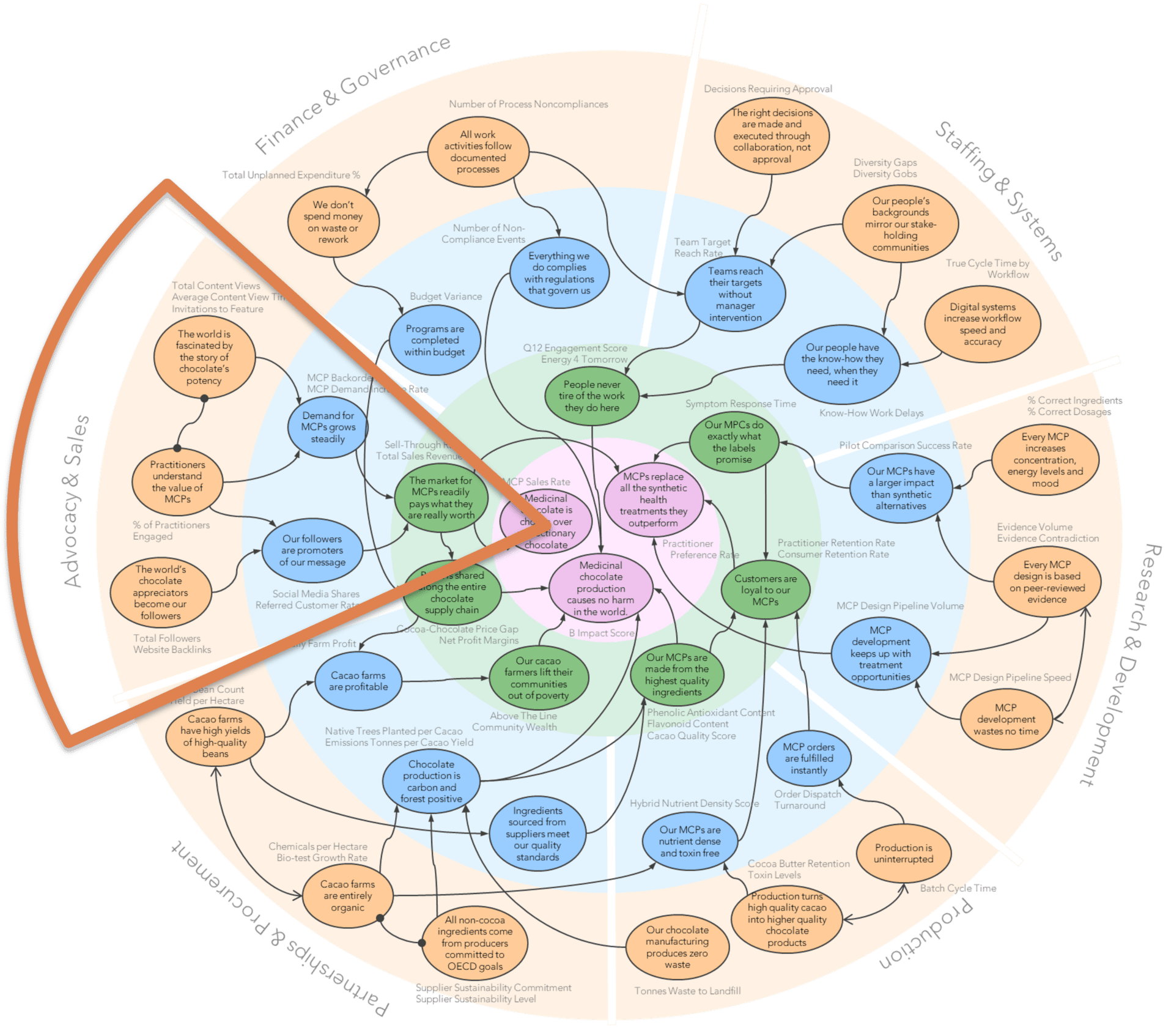
When the full Results Map is built for all departments, something else becomes visible: the links that flow across departmental boundaries. These cross-boundary or cross-silo connections reveal where collaboration is needed, and where teams might inadvertently be working at cross-purposes. They make misalignment visible early — before it causes problems that go unnoticed until they are already costly.
A Results Map shows this fuller story using three distinct types of relationships:
- The cause-effect relationship is a line with an arrow, starting at the cause and pointing to the effect.
- The companion relationship is a line with a solid dot on both ends, ‘holding’ the two results together because both are needed to achieve the desired effects they might each point to.
- The conflict relationship is a line with an arrow on both ends, but a different style of arrow from that used for the cause-effect arrows, and they highlight where there is a tension or competition between two results that needs to be balanced or mitigated.
Without all three relationship types, teams might think they are choosing the right action to execute strategy, but can’t always see how that action could be leveraged with collaboration, or could be sabotaging other teams’ results.
Try this:
Map out the results your team is responsible for. Then ask: which other team’s results do we depend on, and which other teams depend on ours? Even a rough sketch of these dependencies will start to reveal the alignment gaps — and the alignment opportunities — in your organisation. This introductory guideline on Results Maps might help.
This approach creates the cultural breakthrough leaders are looking for
Back to that elephant in the room: many leaders will reach for culture as the explanation when strategy execution isn’t working. “We have a culture problem.” “We need to change the culture.”
But culture is a symptom, not a cause.
When teams don’t share a clear line-of-sight to results, they miss out on the leverage of unanticipated collaboration and suffer the sabotage of unintentional competition. Performance conversations become territorial. People protect their patch because they don’t have a shared picture of what they’re all working toward.
When you do build that shared line-of-sight — through the Results Map — collaboration becomes structurally easier. You don’t have to push people toward it. The structure itself creates the conditions for it.
The shift from activity-monitoring to results-focus also changes how people talk about performance. “Are we on track with the project?” becomes “Is the result we care about actually moving in the right direction?” That’s a fundamentally different — and more useful — conversation.
This is the “aha” moment that leaders often describe after building their first Results Map. Not just for a better measurement system or way to communicate strategy, but a better way for the organisation to see itself.
Try this:
Brook Rolter, PuMP Partner for the US, created a simple self-diagnostic you can use to test the extent of your organisation’s strategy alignment problem, and you can download it at Brook’s website, here.
The strategy alignment problem has a structural fix
Strategy drifts because shared clarity is assumed, and team contribution is activity-based.
When strategy is written as actions or vague aspirations, every team reads it through their own lens. When strategy is rewritten as clear results, teams can see where they fit and what they need to achieve. When evidence of success is defined for those results, performance conversations become grounded in the real world. And when all of this is connected in a Results Map, every team has a line-of-sight from their daily work to the outcomes that matter most — the outcomes that are in front of them, above them and beside them.
That’s not a communication tactic or a culture change program. It’s a structural fix.
If strategy alignment in your organisation feels harder than it should be, the PuMP Results Map is a practical place to start — and your leadership team can experience a taste of this, obligation-free, in a PuMP Discovery Discussion.
If you want to share these ideas with your leadership team first, our webcast replay, The Strategy Alignment Problem, is available anytime.