
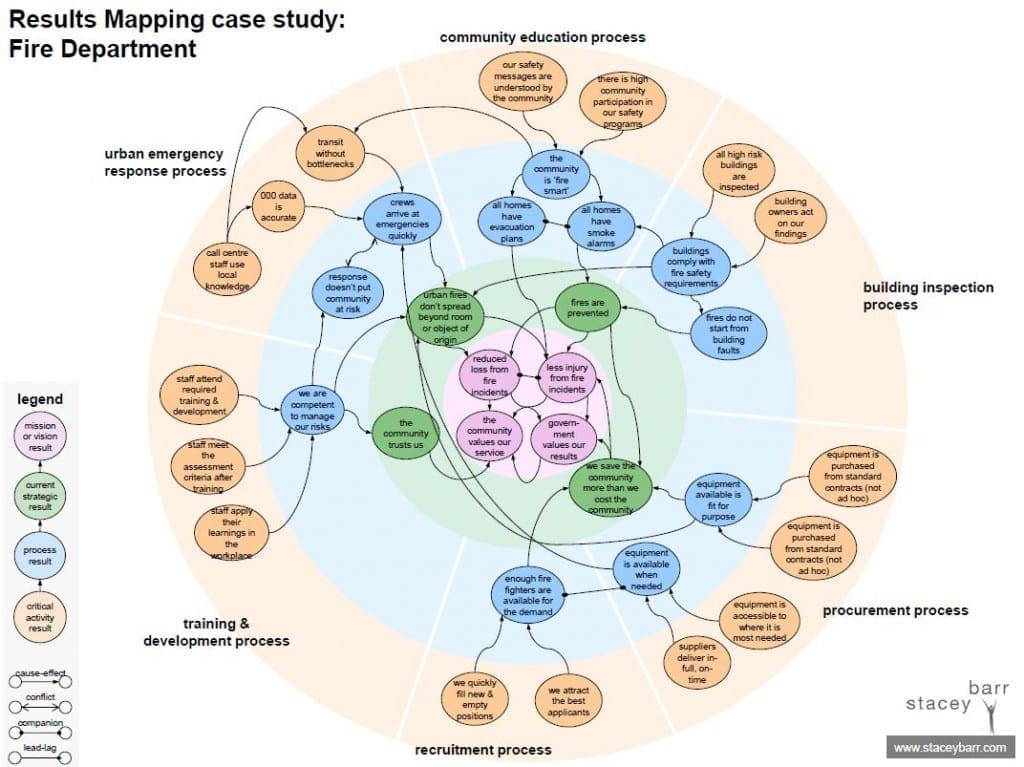
The power of strategy maps lies in their succinct and visual presentation of a strategic direction, in a way that highlights the cause-effect relationships that align every team’s goals to that strategic direction.
It’s a brilliant thing, to be able to see the big picture of your organisation’s strategy in one view, on a single page.
In PuMP, we use a Results Map to do this. One leader, Hanlie, walks us through her Results Map and how it works to align her teams to the strategic direction:
So, why is the Results Map designed this way?
The zones in a Results Maps make cascading and aligning strategy easier.
There are almost always four zones in a Results Map:
- The pink zone is the middle zone. It’s where results implied by your mission and vision belong.
- The green zone is the next one out, and it’s where the results implied by your (usually weasely or vague or action-oriented) strategic plan belong.
- The blue zone is where results implied by departmental or customer-facing business process outcomes belong.
- The orange zone is where results implied by teams or business units or sub-processes belong.
These zones are arranged in a way that you can see how strategy cascades outwards from the centre, and how people can see alignment from their work through to the organisation’s purpose.
The bubbles in a Results Map are measurable performance results.
There is no place for actions on a Results Map. If we try to measure things like ‘train staff in negotiation’, we’ll just end up with a trivial measure like ‘number of staff trained’ which has no power to inform us about the results we want from training staff.
And there is no place for weasel words on a Results Map. If we try to measure something like ‘enhance innovation’, we’ll end up with a uninformative measure like ‘number of new ideas generated’. Bleh. No power to inform us about results with that measure, either.
Each bubble on a Results Map contains a unique performance result that is expressed as “future facts“, like these:
- Customers are loyal.
- Delivery cycle time matches what the customer was promised.
- Employees are not harmed at work.
Wording performance results this way makes it easier to visualise the state we want to reach, which consequently makes it easier to find meaningful measures.
The relationships tell a fuller story than just cause-effect.
If we focused only cause-effect relationships between goals, we’d be a great risk of ignoring unintended consequences and surprising synergies. That’s why there are three relationship types on a Results Map, which make it a stronger systemic map of our strategic direction:
- cause-effect, which means that by achieving one result, the other is more likely to be achieved
- companion, which means that both results are synergistic and need to be achieved together
- conflict, which means that achieving one result puts the other result at a high risk of being sabotaged
Strategy is often nonlinear, and the Results Map allows us to tell the story of strategy more flexibly.
Performance measures are evidence of performance results.
The Results Map is the technique we use at Step 2 of the PuMP Blueprint methodology to make a set of objectives or goals measurable. There’s no point trying to measure a strategy that is written in vague or weasely language – we need to understand what impact we are trying to create in the real, tangible, sensory world. That means changing how we write goals so we can measure them.
When the measures for each performance result are designed, we put them on the Results Map, next to their goals, to complete the story of the strategy.
Where’s Wally?
Or, if you’re not in Australia, ‘Where’s Waldo?’
One of our first Results Mapping clients (the Director of a government agency) nicknamed it the Where’s Wally Diagram. That was for two reasons.
Firstly, it was because the Results Map is, admittedly, quite a busy diagram on first glance. Not quite as bad as looking at a Where’s Wally cartoon, though! And you can successfully explain it in just a couple of minutes, anyway.
Secondly, and mainly, it was because once Wally was found in the map, Wally knew where they fit into the organisation. Wally had a line of sight from their work results through to the organisation’s priorities and purpose. That’s pretty neat. And that’s a strong and practical foundation on which successful strategy execution can be built upon.
The Results Map is core technique taught in our PuMP Blueprint programs and facilitated with you in our Evidence-Based Leadership Program. If you’d like an exploratory chat about how the Result Map can work for you, book a complimentary Discovery Discussion with us: