

What is Evidence Based Leadership?
Most leaders make decisions based on experience, instinct, and what’s worked before. Not because they’re careless — but because the evidence they need to do otherwise is simply not there.

The strategy is written. The KPIs are in the dashboard. The reports go out every month. And yet, underneath all of it, there’s a creeping sense that the organisation isn’t really moving. A sense that the goals are harder to execute than they looked on paper, and that the numbers aren’t actually telling anyone what they need to know.
This shouldn’t be mistaken as a leadership problem — it is almost always a measurement problem. And it’s a problem more common than most leaders realise.
Evidence-based leadership offers a different way forward — one grounded in how high-performing organisations actually work, not how we assume they do. It’s also the framework at the heart of everything PuMP does.
Where the idea comes from
Evidence-based leadership has roots in evidence-based medicine, which emerged in the late 1960s when a group of doctors began asking an uncomfortable question: were clinical decisions actually based on evidence, or on expertise, habit, and assumption?
The answer was unsettling. As researchers Jeffrey Pfeffer and Robert Sutton later observed in their landmark work on management, the same gap existed in organisations — decisions driven by hope, fear, and ideology rather than facts. Their conclusion was blunt: if doctors practiced medicine the way most organisations practice management, there would be “far more sick and dead patients, and many more doctors would be in jail”.
Evidence-based management emerged as a response — the deliberate application of the best available evidence to decisions about how organisations are run. Evidence-based leadership takes that one level higher: it applies this rigorous, evidence-grounded approach specifically to the work of senior leaders, at the level of strategy, culture, and organisational direction.
What evidence-based leadership actually is
Evidence-based leadership is not about how to lead. It’s not about communication style, emotional intelligence, or which decision-making framework to use.
It’s about what to lead your organisation toward — and how to know, with genuine confidence, whether you’re getting there.
Most leaders are good at setting direction. Fewer have the tools to know whether that direction is being executed, or whether the organisation’s performance is actually improving. Evidence-based leadership closes that gap. It means practicing and inspiring the habits that connect strategy to results — and that replace guessing with knowing.
There are three things evidence-based leadership requires of an organisation:
- The application of evidence-based management at the whole-organisation level, and the active support of that practice organisation-wide.
- The alignment of all decision-making and action with the purpose and strategic direction of the organisation.
- Measurably elevating the overall performance of the organisation and its positive impact in the world.
The key word is measurably. Without meaningful measurement, there is no evidence. Without evidence, there is no knowing. And without knowing, even the best leaders are, in the end, guessing.
What’s missing from the popular conversation on evidence-based leadership
Search for “evidence-based leadership” and you’ll find plenty of content about reducing cognitive bias, making better decisions, and being more “data-informed.” This is valuable, as far as it goes.
But it stops well short of what organisations actually need.
Most approaches to evidence-based leadership focus on individual leader behaviour — specifically, how a leader can think more clearly and decide more carefully. What they don’t address is the systemic question: how does evidence become embedded in the culture and structure of the organisation, not just the thinking habits of its senior team?
Three things tend to be missing:
- A results-oriented strategy. Most strategic goals are written as actions — things to do, programs to deliver, initiatives to complete. An action-oriented strategy can’t be meaningfully measured, because there’s no result to measure against. And if it can’t be meaningfully measured, it can’t be known whether it’s working. Evidence-based leadership requires that the organisation’s strategic direction be expressed as results: the actual outcomes that would tell you the strategy is succeeding.
- Measurement that quantifies evidence, not activity. Having KPIs is not the same as having evidence. Most KPI sets measure what’s easy to count — inputs, outputs, compliance indicators — rather than the results that actually matter. Evidence-based leadership calls for measures that are directly connected to strategic goals, designed as genuine evidence of those goals being achieved, and used to learn and improve rather than to judge and report.
- A framework that extends organisation-wide. Even the most evidence-minded leader can’t create a high-performance culture alone. Evidence-based leadership isn’t just a set of individual habits for the executive team. It’s a way of working that has to be aligned, embedded, and inspired throughout the entire organisation — from strategy at the top to decision-making at the team level. That requires a complete framework, not just a leadership disposition.
The EBL framework: six habits of high performance
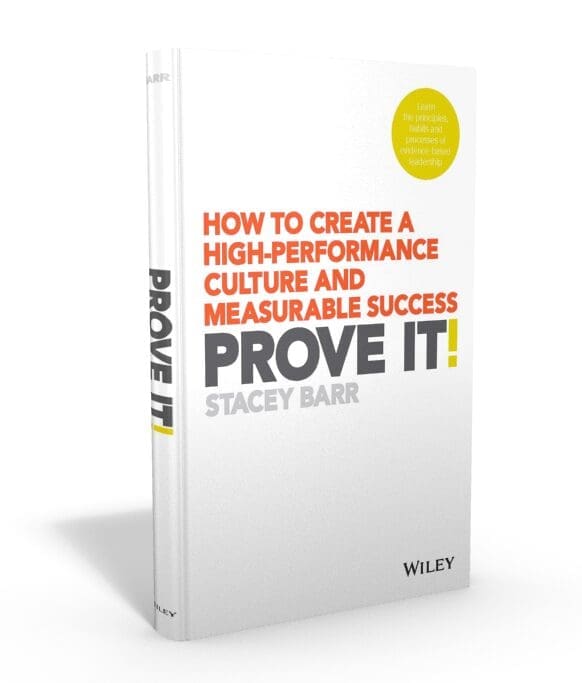
The Evidence-Based Leadership framework, developed by Stacey Barr and detailed in her book Prove It!, comprises six interconnected habits organised across two tiers. The full framework is the practical engine of evidence-based leadership — turning the concept from an aspiration into something an organisation can actually practice.
The Evidence-Based Leadership framework is detailed in Stacey Barr’s book Prove It! — a practical guide to creating a high-performance culture and measurable success.
The three leadership habits — what executives practice and model
These habits describe the role of the senior leadership team. They’re about what leaders give their attention to, the standards they hold themselves to, and the role model they are for the rest of the organisation.
1. Direction — through strategy
Direction means articulating a well-designed strategy that is results-oriented, understandable to everyone, and ruthlessly prioritised. Most strategies fail in execution not because of poor leadership, but because they’re written as intentions and actions rather than as results. A strategy built on the Direction habit makes the destination clear enough to measure — and clear enough for everyone in the organisation to understand and align behind.
The three mindset shifts that define Direction are: results, not actions (goals describe outcomes, not things to do); no weasel words (goals are written in language a ten-year-old could understand); and be ruthless (the more goals you have, the fewer you’ll achieve).
2. Evidence — through measuring
Evidence means setting meaningful performance measures for each strategic goal — measures that are quantitative, aligned to what matters, and focused on improvement rather than compliance. The purpose of measurement isn’t reporting; it’s knowing. And knowing requires that measures be designed as genuine evidence of results, not proxies for activity.
The three mindset shifts that define Evidence are: learning, not judging (evidence is something people use, not something used on them); evidence before measures (start with what would convince you the result is happening, then quantify it); and measure what matters (measures must be aligned to mission, vision, and goals — not just what’s easy to count).
3. Execution — through leverage
Execution means getting the corporate strategy implemented and strategic goals achieved — not through force of will or the requirement for additional ongoing resources, but through the leverage found in improving the business processes that drive performance. The most common mistake in execution is investing in initiatives that feel productive but don’t move the needle on results. Evidence-based execution means finding and fixing the real causes of performance gaps.
The three mindset shifts that define Execution are: leverage, not force (work smarter, not harder); patterns, not points (removing variability is more useful than hitting a single number); and processes, not people (performance problems live in processes, not in individuals).
The three organisational habits — what executives inspire and embed
These habits extend evidence-based practice throughout the organisation. The leadership team doesn’t just practice them — they actively create the conditions for everyone to practice them too.
4. Decision — through focus
Decision means helping every person in the organisation take ownership of the results that matter — by giving them a clear line of sight to the corporate strategy, communicating it in a way that invites genuine buy-in, and giving them the authority to improve the processes they work in. Strategy cascades most effectively not through directives from above, but through cause-and-effect — each team understanding how their work contributes to results that matter.
The three mindset shifts that define Decision are: align, don’t fragment (a cause-effect line of sight to strategy, not fragmented copies of the strategy); buy-in, not sign-off (communicate strategy in a way that engages ownership, not compliance); and working on, not just in (give people authority to improve their processes, not just to follow them).
5. Action — through targets
Action means helping people get the right things done to close performance gaps — through a focus on understanding the real causes of poor performance, practical improvement, and collaboration across the organisation. Accountability in an evidence-based organisation isn’t about holding people responsible for numbers; it’s about providing the conditions for them to confidently monitor performance, interpret what’s driving it, and initiate the right response.
The three mindset shifts that define Action are: causes, not symptoms (remove the constraints that limit performance, not the visible symptoms); practical, not perfect (when a solution is 80% there, it’s good enough to test); and collaboration, not competition (help people work across the organisational whitespace to close gaps together).
6. Learning — through testing
Learning means helping people find the fastest and most cost-effective way to close performance gaps — by treating improvement initiatives as experiments, learning from both success and failure, and iterating toward what works. In a high-performance culture, there is no such thing as a failed experiment. Any test that yields useful data is valuable.
The three mindset shifts that define Learning are: experiments, not assumptions (isolate and quantify the impact of changes before rolling them out); no failure, only feedback (celebrate learning from every outcome, whether it moved in the right direction or not); and iterate, don’t procrastinate (smaller goals, tested sooner, speed up the journey to success).
Why this framework is uniquely powerful — and why it needs PuMP
The six habits make sense at a conceptual level. But any organisations will struggle to practice them if they’re working with measurement that isn’t fit for purpose.
Vague strategic goals are not measurable. Activity-based KPIs can’t serve as evidence. Dashboards built on the wrong measures generate reports — but not insight. And without the right evidence, leaders have no reliable signal about what’s actually happening in their organisation. Leading blind is an unnecessary stress every leader can avoid.
This is where PuMP comes in. PuMP is the performance measurement methodology that makes evidence-based leadership practical. It provides the specific techniques — for making goals measurable, designing meaningful measures, creating performance reports that drive learning, and cascading strategy in a way that builds genuine alignment — that turn the EBL framework from a set of good intentions into something an organisation can actually do.
EBL is the what. PuMP is the how.
The two have been developed together over more than 30 years of working with leadership teams across government, corporate, and non-profit organisations. They’re not independent ideas bolted together — they’re designed to work as a unified system.
What evidence-based leadership looks like in practice
Creating evidence-based excellence
When Dell Anderson became Executive Director of Renew Behavioral Health and Wellness — a behavioural health provider serving Grant County, Washington State — he knew the organisation needed to change. But despite strong intentions and a clear vision, something was missing.
“I was asked a question about what evidence we have that we are successful in implementing what we set out to do,” Dell reflects. “And I didn’t have an answer for that.”
Renew had compliance data. It had reports. What it didn’t have was a way to tell the story of whether it was achieving its mission — or a measurement system that could guide continuous improvement across the organisation.
Through PuMP and the Evidence-Based Leadership framework, Renew built that system. The senior leadership team worked through every element of their strategy — rewriting goals in plain language, designing measures as genuine evidence of results, and creating a performance dashboard that showed trends over time, not just point-in-time numbers. They cascaded that work across the organisation through a “Data Walk” — a structured opportunity for all staff to see the strategy, the measures, and the real data, and to give feedback that was genuinely acted on.
One staff member’s feedback stood out: “They’re actually listening to us. I can see what we asked for in the measure.”
“The end result is tangible,” Dell says. “You’re actually able to tell the story of where you are as an organisation, and get staff buy-in. I’m able to see visually how we’re doing as an organisation, and also see where we still need to improve.”
Dell’s full case study is here.
From activity data to genuine evidence
Hanlie Erasmus, Associate Director of Public Library Services at the State Library of South Australia, came to evidence-based leadership from a different starting point — not a crisis of culture, but a crisis of evidence. Leading a consortium of 144 public libraries across the state, she knew her network was doing important work. What she couldn’t do was prove it.
“There was a huge gap in evidence when it comes to the value of public libraries and the impact libraries have in the communities that they serve,” Hanlie explains. The data that existed was all activity — loans, visits, program numbers. What it couldn’t tell anyone was whether any of it actually mattered.
Working with PuMP Partner Mark Hocknell, Hanlie led a team of 15 staff through a two-year process of building an outcomes-based performance framework from the ground up — starting in March 2020, in the middle of a pandemic. The process required rebuilding not just what was measured, but how data was collected, verified, and reported across the entire network. It was, by her own admission, a bigger undertaking than she had anticipated.
What emerged was a framework that could, for the first time, connect a library’s day-to-day activity to its impact on individuals and communities — literacy, informed decision-making, digital access, social connection, and wellbeing. Libraries began using it to build business cases for funding. One regional library used the evidence to lobby successfully for additional program funding and a new funded position. Another used it to justify a major investment in digital resources — Hanlie’s network now operates the largest eLibrary in the southern hemisphere, with loan data to show the investment is working.
But it was a simpler moment that perhaps captures the shift most clearly. For the first time, Hanlie had data showing that nearly half of library customers felt the library had helped them find information they could trust — and that as a result, they felt more confident making important decisions in their lives.
“This is information we never had before,” Hanlie says. “Telling that story with evidence — that was what I think was missing in all of our previous approaches.”
Hanlie’s full case study is here.
Start the conversation
Evidence-based leadership is not a tool you implement. It’s a way of leading that takes time, commitment, and the right support to build.
If you’re wondering whether this approach is the right next step for your team — and what it would actually take to start — a Discovery Discussion is the place to begin.

A Discovery Discussion is a free, one-hour conversation with an accredited PuMP Licensee, built around your own strategic goals. You bring one goal. Your PuMP facilitator brings the right questions. What emerges is yours to keep, whether or not PuMP and EBL are right for you.
Either way, most leaders finish the hour with something they didn’t have before: a specific, concrete next step they feel genuinely confident about.