

Every organisation has a strategy. Far fewer have teams that can tell you exactly how their work is moving it forward. The fix is to cascade strategy in a way that creates real alignment.

Strategy alignment sounds straightforward in theory. Leadership sets the direction, teams set their goals, and everyone rows together. In practice, the gap between a well-crafted organisational strategy and what actually happens at team level is one of the most persistent and costly problems in strategy execution. Traditional ways to cascade strategy generates team goals that are often too generic, too disconnected, or just a vague echo of what’s written in the strategic plan.
The good news is that there are structured ways to close that gap — ways to cascade strategy that produce genuine cause-and-effect logic between what every team does and what the organisation is trying to achieve. But before we get to those, it’s worth looking honestly at why the most common strategy alignment approaches fall short.
What we mean by “cascading strategy” — and the terms people use
Connecting team-level goals to organisational strategy goes by several names: cascading strategy, deploying strategy, translating strategy, or simply strategy alignment. Whatever the term, the intent is the same: every part of the organisation should have goals and measures that genuinely contribute to the overarching strategic direction, with a visible and logical cause-effect chain linking them.
“Cascading” is probably the most widely used term, and we’ll use it here too. But it’s worth knowing that the word implies a top-down flow that can sometimes obscure a more important question: not just whether goals have been passed down, but whether they actually connect in a way that drives the right results.
That connection — making the cause-effect logic explicit and measurable — is exactly what the PuMP Results Map is designed to do. It’s a one-page visual tool that maps the results an organisation is trying to achieve, and the cause-effect relationships between them, from strategic goals right through to team-level goals. Both of the recommended cascading methods in this article work through a Results Map.
Three common approaches — and why they fall short
Before exploring the two structured methods, it helps to understand what most organisations actually do — and what the limitations are.
Approach 1: Informal alignment (no structured method at all)
In many organisations, there’s no deliberate process for translating strategy into team goals. Teams are pointed at the strategic plan and expected to figure out their contribution themselves. Some teams connect meaningfully. Many don’t. The result is a patchwork of goals that may look aligned on paper but lack any logical chain connecting them to strategic outcomes. Measurement becomes arbitrary — teams measure what’s easy rather than what matters.
Approach 2: The “mini me” method
“Mini me” cascading is the most common structured attempt. Teams take the organisation’s strategic goals and localise them — so “reduce corporate costs” becomes “reduce our team costs”, or “improve customer satisfaction” becomes “improve our team’s customer satisfaction”. It feels logical, but it has a fundamental flaw: a team’s local version of a strategic goal isn’t necessarily what causes that strategic goal to be achieved. A customer service team reducing its own costs might have no relationship at all to what’s actually driving corporate cost growth. The causal logic is assumed rather than demonstrated.
Approach 3: Tiered scorecards
Frameworks like the Balanced Scorecard introduced the idea of cascading scorecards — each tier of the organisation has its own scorecard that reflects the level above it. This is more disciplined than the “mini me” approach, and the four-perspective structure does encourage broader thinking about what to measure. But scorecards at each level tend to sit side-by-side rather than reveal the cause-effect links between levels. You can end up with a set of departmental scorecards that look complete and coherent, while the actual logic connecting team performance to strategic outcomes remains implicit, untested, and invisible.
What all three of these approaches have in common is that they produce the appearance of alignment without the logic of alignment. And without that logic, you can’t be confident that improving team-level performance will actually move the strategic needle.
Method 1: Cascading through organisational structure (functional cascading)
How it works
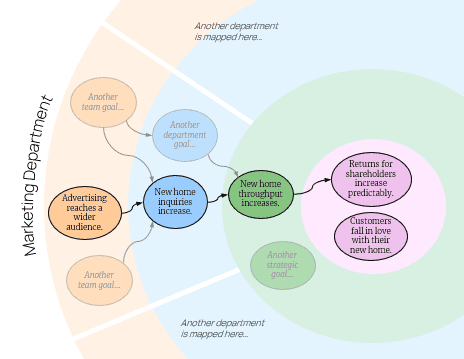
Functional cascading follows the organisation’s formal structure — the hierarchy of departments, divisions, business units and teams. Each level sets goals based on what the level above it needs to achieve. In a Results Map, this means the cause-effect chain is built by tracing contributions up through the organisation’s structure (a.k.a. org chart).
The process typically works like this:
- Each department examines the organisational strategic goals and defines the departmental outcomes that would most directly contribute to them.
- Each division or business unit within the department does the same, defining outcomes that contribute to the departmental goals.
- Each team does the same for the level above it.
- Once the contributions to strategic direction are mapped, each department, division, business unit and team will check for impacts their outcomes might have on outcomes in other parts of the organisation, to flag any important relationships across the organisational white space.
The key discipline — and what separates this from the “mini me” approach — is that each level has to articulate a genuine cause-effect relationship to the strategic direction, not just a thematic resemblance. The Results Map makes this explicit by drawing the links visually.
Consider a construction company building family homes. It has a strategic goal of “New home throughput increases”. The Sales & Marketing department determines that “New home inquiries increase” is a genuine contributor to throughput. Within that department, the Marketing division determines that “Advertising reaches a wider audience” is what drives inquiry volume. Each goal is set because of its logical contribution to the one above it — not just because it sounds related.
When it works well
Functional cascading is the right alignment approach when:
- Your organisation doesn’t yet have a documented process model, and building one isn’t a realistic near-term option.
- Accountability and budgeting already align to the org chart, so functional goals slot into existing structures naturally.
- You need a practical starting point that leadership can implement without a steep learning curve.
- You’re committed to using a Results Map to make cause-effect links explicit at each level — keeping the cascade honest and out of “mini me” territory.
Where it falls short
To get the most from functional cascading, there are a few things to keep an eye on:
- It’s easy to ignore the white space. White space problems don’t surface automatically. The hand-over points between departments and teams — where work passes from one group to another — aren’t built into the structure of a functional cascade the way they are in a process model. That’s why Step 4 matters: without a deliberate check across those boundaries, one department can optimise its own goals while inadvertently creating a bottleneck or quality problem for another. A construction company that drives up sales inquiries without any visibility of the design team’s capacity to handle them is a classic example.
- The cause-effect chain can weaken. The further you cascade down the hierarchy, the more tenuous the logical connection to strategic goals can become — especially in large organisations with many structural layers.
- It can scatter improvement energy. When every team is trying to improve something related to the strategic goal, effort can be distributed across dozens of initiatives rather than concentrated on the one or two places where real bottlenecks exist. In some cases, there may be teams that do not have a performance gap that aligns to the strategic direction — and making up connections can end up wasting resources.
These limitations can be avoided if an organisation is ready to try the second method: process cascading.
Method 2: Cascading through business processes (process cascading)
Before we go further, it’s worth pausing on what we mean by a business process — because process thinking is not yet second nature for many leaders.
What is a business process?
A business process is the sequence of tasks and activities — across departments and teams — that delivers a product or service to a customer or stakeholder. The word cross-functional is the key one here: processes don’t respect org chart boundaries. They flow through multiple departments and teams to produce an outcome. Resolving a customer complaint, onboarding a new employee, assessing and approving a grant application — each of these is a process, even if no one has ever drawn it on a page.
Process thinking has been developed and refined over decades. Geary Rummler and Alan Brache’s Improving Performance is one of the foundational texts, and their concept of the “white space” — the gaps between boxes on the org chart where things fall through — is directly relevant here. Michael Hammer and James Champy’s Reengineering the Corporation brought process thinking into mainstream management. For a more contemporary and practical framework, the APQC Process Classification Framework offers a structured way to identify and categorise an organisation’s core processes.
How it works
Instead of following the org chart, process cascading identifies the organisation’s main end-to-end processes and uses them as the structure for goal-setting.
- The organisation’s core processes are identified and mapped — the end-to-end flows that deliver value to customers or stakeholders.
- Each process team examines the strategic goals and defines the process outcome goals that would contribute to them.
- The process flow is analysed to find bottlenecks and weak links — the places where performance is being constrained.
- Sub-process teams set goals that address those specific constraints.
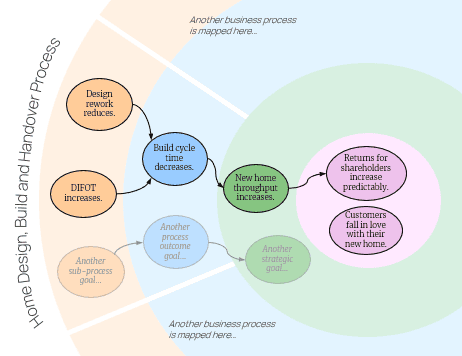
The key discipline of process cascading — that separates it from functional cascading — is that cross-functional teams need to work collaboratively to map each process to the strategic direction. The Results Map works just as well here too, with its sections defined by business processes instead of functional departments.
Returning to the construction company, the same strategic goal — “New home throughput increases” — is now approached through the Home Design, Build and Handover process. The process team determines that “Build cycle time decreases” is the key process outcome. Analysing the process flow, they find two bottlenecks: rework in the design approval sub-process, and procurement delays. The design approval sub-process sets the goal “Design rework reduces”; the procurement sub-process sets “DIFOT increases” (delivery in full and on time). Every goal is set because the process analysis shows it is a real constraint on throughput — not because it sounds related to the strategic goal.
When it works well
Your organisation might be ready for process cascading when:
- Cross-functional collaboration is a priority, and you want goals that require teams to work together rather than independently.
- Internal competition for resources, or “white space” problems between departments, are already visible.
- Your organisation has a process model, or has the readiness and capacity to build one.
- You want to find where the greatest leverage for improvement actually lies — and focus resources there rather than spreading them across the organisation.
Where it falls short
For process cascading to work well, a level of readiness is needed:
- Most organisations don’t have a process model. Building one is significant work, and doing it well while simultaneously trying to cascade a strategy can be overwhelming.
- There’s no single right answer. Unlike an org chart, which is fixed and agreed, a process model involves judgement calls. Teams can spend considerable energy debating whether they’ve drawn the right boundaries, which can stall progress.
- Leadership readiness matters. Process cascading requires leaders to think about their organisation differently — less as a hierarchy of roles and more as a system of flows. That shift isn’t always easy or quick.
Which method is right for your organisation — right now?
Both methods produce genuine alignment when applied well, and both work through a Results Map that makes the cause-effect logic explicit. The question isn’t which is theoretically superior — it’s which is the right fit for where your organisation is today.
Use these questions to find out:
Diagnostic: Which method is right for us?
- Does your organisation have a documented process model — even a simple one? If yes, process cascading is within reach. If no, functional cascading is the more practical starting point.
- Are “white space” problems already visible — hand-over failures, internal competition, or goals that conflict across departments? If yes, those are symptoms that functional cascading alone won’t fix. Process cascading addresses the root cause directly.
- Is leadership comfortable with the idea that the org chart doesn’t fully explain how value is delivered? If yes, they’re likely ready to think in processes. If no, functional cascading gives them familiar ground while still building meaningful alignment.
- Does your organisation have ample resources to invest in the strategic alignment process itself? If yes, you likely have enough capacity for the upfront work process cascading requires — and it will produce more durable results. If no, functional cascading is faster to get started.
- Do most of your strategic bottlenecks span multiple departments? If yes, the bottlenecks cross departmental boundaries, and only process cascading will find them. If no, bottlenecks are mostly within departments, and functional cascading can surface them.
Mostly “yes”: Process cascading is likely the right method — and the investment in building a process model will pay off.
Mostly “no”: Start with functional cascading. It’s not a lesser option — it’s a legitimate and practical method that many organisations use successfully. You can always build toward process cascading as your organisation’s process maturity grows.
A final thought…
The method you choose matters less than the discipline of making the cause-effect logic visible at every level. That’s the work the Results Map does — and it’s what separates meaningful strategy alignment from the appearance of it.
Whether your teams are aligned through the org chart or through processes, the question to ask at every level is: if this goal is achieved, does it genuinely and demonstrably contribute to the goal above it? If you can answer yes with confidence, your strategy is aligned. If you hesitate, you have more work to do.
Is your strategy truly reaching every team?
A free Discovery Discussion can show you exactly how the Results Map brings your strategy to life across your entire organisation — and which cascading method suits where you are right now.
In one hour, we’ll explore your current strategic direction with you and show you what meaningful alignment looks like in practice. No preparation, no commitment — just clarity on where to start.