

The journey to performance measurement maturity has 8 critical milestones. Which one is your organisation currently at?

I guess there’s a better first question to ask, than what level is your organisation’s performance measurement maturity at. It’s this: why do you want to know? I can think of three reasons:
- If we’re going to put effort and resources into measuring performance, surely we need to be aware that we’re doing it well enough.
- If our performance measures aren’t working out for us the way we want, it’s good to understand why, and what the best thing is to fix it.
- If we are serious about measuring our performance to improve it, then it’s a natural extension to measure our measurement so it can improve too.
- A bonus reason I just thought of: it’s fun to gamify things.
If one of these reasons resonates with you, then read on to find out how to download the kit to calculate your organisation’s performance measurement maturity score.
The PuMP Performance Measurement Maturity Score
As with any model, they are always under development until they converge into a version that remains stable under further testing. This model has evolved over the last 25 years or so that I’ve been thinking about performance measurement maturity.
The PuMP Performance Measurement Maturity Score is based on this model. The data for the score comes from a 26-criteria version of the PuMP Diagnostic, which we normally use to engage teams early in the journey of performance measurement. And the score is aligned to eight levels of the maturity model.
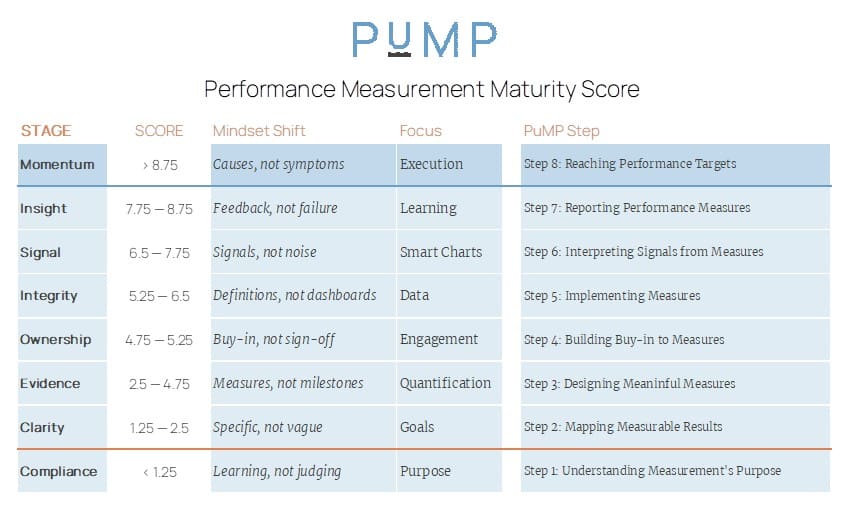
This model has rigour to it, unlike trivial surveys that just ask people what they think of their organisation’s approach to measurement. Perceptions are not accurate assessments of KPI maturity. We need to base a maturity score on observable evidence of practice.
Eight levels of performance measurement maturity…
Let me show you the model first, then you can try it out. We’re starting at the bottom (where you don’t want to stay) and moving to the top (where you want to aspire to be):
Level 1: Compliance
The focus of level 1 is to make measurement about learning, not judging. When the purpose of performance measurement is control and judgment of people, it generates fear and dysfunctional behaviour. But when people see measurement as a tool to help them learn to improve performance, not a rod for their backs, the foundation of a true performance culture forms.
Your organisation is at level 1 if performance measurement exists mainly as a reporting obligation. People provide data because it’s required, not because it helps them. Measures are handed down, not designed with the people doing the work. The dominant feeling is compliance — and sometimes fear.
KEY TO SUCCESS: When initiating performance measurement, always set the purpose as continual improvement of processes, not as judgement of people’s performance. Psychological safety is the foundation.
Level 2: Clarity
The focus of level 2 is write goals so they are specific, not vague. Most goals are articulated in vague language or ‘corporate-speak’, known as weasel words, and it makes them immeasurable. Before we can find meaningful measures, goals must be written clearly, in language a 5th grader can understand.
Your organisation is at level 2 if there’s growing recognition that vague goals are the root of meaningless measures. The organisation is beginning to rewrite goals in plain, specific language — the kind a new employee could understand and act on. It’s uncomfortable, but the clarity is worth it.
KEY TO SUCCESS: When writing strategic or operational goals, always use words that a 10-year-old could understand, because understandable means measurable. This is what it really means to write SMART goals.
Level 3: Evidence
The focus of level 3 is measures, not milestones. Too many measures aren’t really good measures at all. They are milestones, activities, trivial counts or concepts that aren’t quantitative. Good measures are evidence of our goals. They have to be deliberately designed from objective evidence of those goals.
Your organisation is at level 3 if you’re moving from tracking activities and milestones to designing real measures — quantitative evidence that a goal is actually being achieved. This is harder than it sounds. It requires deliberate design, not just a brainstorm, and many current ‘measures’ don’t survive the scrutiny.
KEY TO SUCCESS: When creating performance measures, always make sure the quantification is based on direct and observable evidence. There is a process to design good KPIs.
Level 4: Ownership
The focus of level 4 is buy-in, not sign-off. When goals are understandable and measured meaningfully, engagement becomes possible — people suddenly see how to contribute to what matters in the organisation. They see that performance measurement’s purpose is continuous improvement of processes, and ownership of measures is easier.
Your organisation is at level 4 if, when measures are meaningful and connected to real goals, people start to see how they can contribute. Ownership shifts from a small team of analysts to the people actually doing the work. Measures feel like useful tools, not performance traps. However, building maturity from here might get harder before it gets easier.
KEY TO SUCCESS: When selecting performance measurements, always put the decisions in the hands of the people who own and use those measures to improve their processes. Using Measures Teams is a great way to start.
Level 5: Integrity
The focus of level 5 is definitions, not dashboards. Ownership of meaningful measures to improve processes creates desire for those measures to be accurate; using data to tell the truth about performance. More people feel confident to improve the details of implementation of their measures, from data definition to measure calculation.
Your organisation is at level 5 if owning a measure creates real motivation to make it trustworthy. People start digging into data definitions, calculation methods, and collection processes. The question shifts from ‘what does this show?’ to ‘does this actually tell us the truth?’
KEY TO SUCCESS: When implementing performance measures, always prioritise the right data and the right calculations, before building those pretty dashboards. It can simply start with choosing the best way to calculate each KPI.
Level 6: Signal
The focus of level 6 is signals, not noise. Truthful performance measures show how performance is changing through signals of statistical change over time — and Smart Charts are the way to see those real signals. People are no longer distracted by comparisons between individual measure values. It’s the true signals of change that give the knowledge about performance.
Your organisation is at level 6 if you are using statistical thinking to read your measures properly. People no longer react to every up or down movement. They can distinguish genuine signals of change from natural variation. This reduces wasted effort and improves the quality of decisions.
KEY TO SUCCESS: When analysing performance measures, always use statistical rigour to reveal the true signals of what performance is doing. Try this by using XmR charts for your KPIs.
Level 7: Insight
The focus of level 7 is feedback, not failure. People use measures the way scientists use them: to test the results of experiments, and through this learning, improve performance. There is no failure if there is learning. Information that leads to learning is insight, because it is perceived as constructive feedback to guide action.
Your organisation is at level 7 if measures are now used the way scientists use experiments — to learn, not to judge (yes this, again). When performance doesn’t improve as expected, people investigate with curiosity rather than defensiveness. Every result, including a disappointing one, is treated as information that guides the next action.
KEY TO SUCCESS: When reporting performance, no matter the medium or method, always make sure the insights lead to learning and action. This is easier through how you design your performance reporting.
Level 8: Momentum
The focus of level 8 is causes, not symptoms. Performance measures trigger investigation into what works and what doesn’t work in the execution of strategy and the continual quest for improved performance. And at the base of this quest is the search for the root causes that offer the highest leverage for performance improvement effort.
Your organisation is at level 8 if performance improvement is self-sustaining. Measures routinely prompt investigation into root causes, and the organisation has the capability and the habit to act on what it finds. Improvement efforts are targeted, evidence-based, and increasingly effective. Measurement is no longer a system people work within — it’s a way the organisation thinks.
KEY TO SUCCESS: When executing strategy and change initiatives, always treat the root cause, not the symptoms, of not-good-enough performance. This means using fundamental performance improvements, not bandaids.
The impact of higher measurement maturity
Mastery of performance measurement is more than just the routine of using a deliberate approach to measure for continuous improvement. It is the feedback system that helps everyone make evidence-based decisions that create and sustain organisational excellence. Mastering performance measurement as one of the fundamental organisational management systems that gives leaders the power to tap the real potential locked up within their organisation so it can create the impact it was meant to.
Now… are you ready to find out your score?
Calculate your organisation’s performance measurement mastery…
The PuMP Measurement Maturity calculation is done via the PuMP Diagnostic Discussion. Here’s what to do:
- Download the PuMP Diagnostic kit, below.
- Ideally with a few colleagues, work through the 26 criteria to rate your organisation.
- Go to the Maturity Score worksheet to see your score, and what it means.
- What skills or knowledge or new systems do you need to lift your score from this level?