
Programs and projects need KPIs to measure their performance. But how do program KPIs relate to other organisational and strategic KPIs?

A few years ago I was in Africa, teaching PuMP to a group of professionals in the banking sector.
One of the little things that has stuck in my mind is a ‘a-ha moment’ that happened for one group. The leader of the organisation’s performance improvement team suddenly realised they should be collaborating with the performance measurement team.
This might seem obvious, but it easily happens when people don’t already have a map of how improvement projects should map to organisational performance.
Programs and projects are like staircases and steps. A single program comprises several projects to get to where it’s going. Each project might have different outputs, but collectively they contribute to achieving the program’s outcome. To successfully map programs and projects to organisational performance, this logic has to be clear.
Don’t be like this:
“A more worrying recent trend has been for organizations to start classifying quite simple projects as “programs” in an apparent attempt to avoid the necessity of defining the specific “product, service, or result” that they need.” – PMI
There are clear ways to measure the performance of a project as it is implemented. But what’s challenging is making the link to program outcomes and organisational results.
Programs and projects differ to business functions and processes.
Part of any business model is the design of the functions and processes that people work in to perform the operations of the business or organisation. These are often mapped in an organisational structure diagram.
Functions and processes describe how routine work gets done in the business, like marketing, selling, customer service, financial management, recruitment and information management. Functions and processes are perpetual and ongoing, and probably what most employees describe as their job, or the ‘real work’.
Programs and projects, however, are about working on the business, rather than in it. So a great start to mapping them to organisational results and KPIs is to realise they are about changing the functions and processes to make them perform better. Programs and projects are started and finished, with distinct start and end times.
It seems that project and program success rates are a bit scary. One, according to Gallup, is that only 2.5 percent of companies successfully complete all of their projects. And they propose the reason is this:
“[O]nce people are given procedures to follow, compliance replaces results. Everybody is concerned about how to do the job, not about the outcome if the job is done well.” – Gallup
Measuring on-time and on-budget is important, but it’s not sufficient for program and project success.
We have programs and projects to change our functions and processes.
One of the primary reasons we have programs of projects is to execute strategy.
Strategy tells us which organisational results matter most right now to improve. Results can only be fundamentally improved when the functions and processes that produce them are redesigned in some way.
And the programs and projects are how we make ruthlessly prioritised and deliberately planned redesigns to our business model.
It’s logical then, that programs and projects are only successful when the measures of strategic results show improvement as a consequence.
Use a Results Map to map programs and projects to organisational KPIs.
A PuMP Results Map captures the hierarchy of performance results, along with their measures, which are prioritised by the corporate strategy and cascaded into to the business model.
Around the outside of the Results Map we can place programs and projects, and show where they have their primary impact:
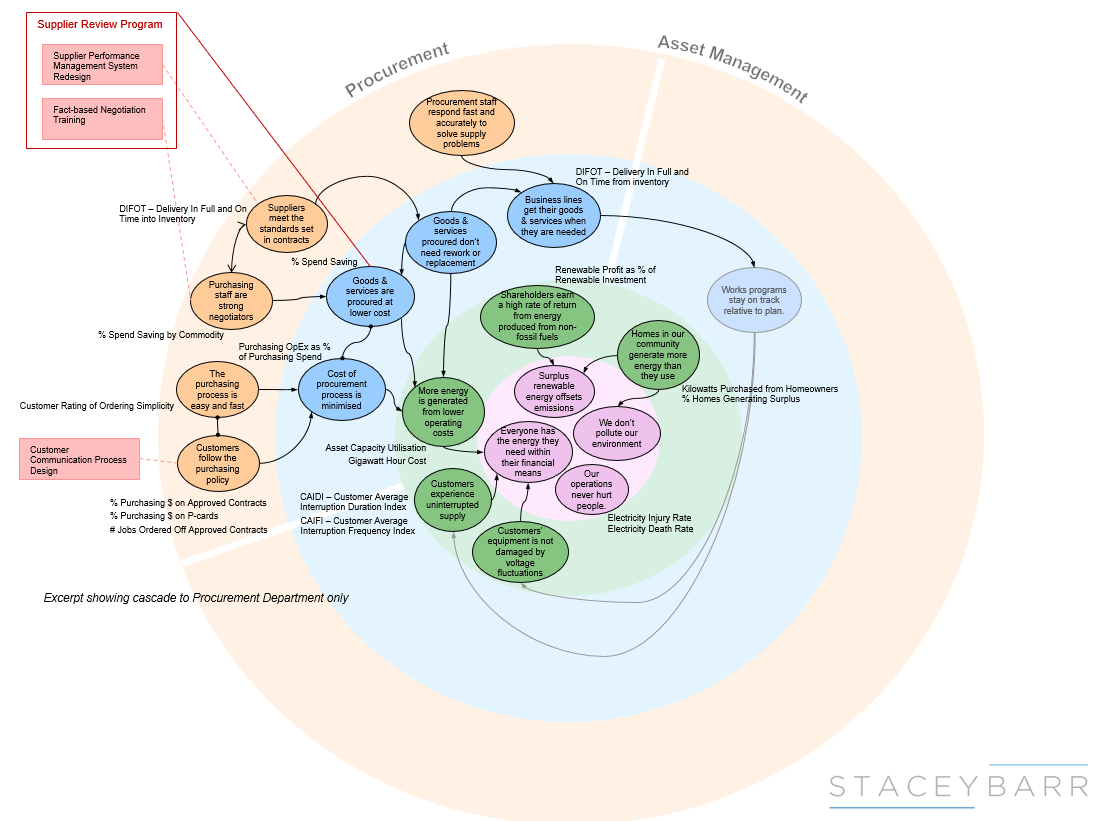
Project success is ultimately a positive change in a strategically important result on the Results Map, and usually linked to an orange result, at the operational level.
Program success is ultimately a positive change in a result on the Results Map too, but usually linked to a higher level than projects, like the blue or green level.
Not only does the Results Map make it crystal clear how programs and projects each map to organisational KPIs, but it also makes the link between project results and program outcomes easier to see. The orange results that a project impacts will link to the blue result that a program impacts.
If a clear alignment can’t be mapped, it suggests two potential problems.
The first problem, if you can’t see a clear mapping to strategy, is that programs and projects may have been chosen outside the context of strategy. This is a problem, because those programs or projects may be using up time and money that really should be spent on strategic initiatives that matter more right now.
The second problem might be that programs are not organised as collections of related projects that each contribute to the same program outcome. This is a problem too, because the confusion and inefficiency will waste a lot of time and money.
When we have limited time and money, we can’t afford to have programs and projects that aren’t clearly aligned to what is strategically important.
If you can’t map programs and projects to organisational KPIs, they were likely chosen outside the context of the current strategic direction, and are wasting resources.
Try this:
Create a rough Results Map (if you don’t already have one), and map a sample of your organisation’s biggest projects to the results that they are designed to improve. If you can’t find any results in the map, check if this is an oversight omission in the strategy, or if the project isn’t strategically important.
Would you like a Results Map for your organisation?
We can help you build a Results Map, with measurable results and meaningful KPIs, to align your projects and programs to.
In a short discovery discussion, we’ll start with one project or program in your current strategic plan and show you how a PuMP Results Map works in practice. No preparation, no commitment — just a concrete experience of what it can look like for your organisation.