

We can struggle to measure and achieve a strategic goal when it’s actually several goals blended together.

When we feel like a strategy is wordy, bloated, difficult to cascade, and too complex to meaningfully measure, it’s a clue we have a ‘multi-focus’ problem.
The ‘multi-focus’ problem is when several performance results are blended together in a single goal statement. But its multi-focus nature leads to two very real risks to strategy execution and achievement:
- Those important performance results blur together, and the risk is that they don’t each get the attention they need to be achieved.
- Often, some of those important results are operational and do not belong in the strategic goal, and the risk is that leadership fails to delegate those results to the teams that should own and execute on them.
Take this goal for example:
“The community are encouraged to improve their health through physical activity and a greater use of active transport networks.”
This goal clearly describes several important performance results. But are they all strategic?
The solution is to unbundle this goal into its individual and specific performance results, which are:
- “The community is healthy.”
- “The community is physically active.”
- “The community uses active transport networks.”
This makes it easier to decide what to measure for each performance result. But it also makes it easier to decide what’s strategic and what’s operational. We can do this by mapping the relationships between these performance results:
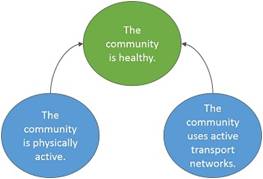
“The community is healthy” is the effect of the other two performance results. This cause-effect relationship helps to position the second two results as causes of the first. When we discover this cause-effect relationship embedded within a single strategic goal, it suggests that the goal is actually made up of performance results that sit at different levels or tiers in the organisation.
It means that we can set the strategic goal as “The community is healthy” and cascade the other two performance results as operational goals. It makes sense, because the two operational performance results would naturally be the responsibility of different business units of the organisation.
So unbundling those multi-focus strategic goals into specific performance results, and mapping the relationships among those performance results, is a great way to keep your strategic goals strategic, and keep it all much simpler.
Try this:
Here’s a quick experiment you can try, to explore the impact of unbundling your multi-focus strategic goals:
- Look over the goals or objectives in your strategic plan.
- Highlight those that have a multi-focus.
- Choose just one of your multi-focus goals.
- Spend a few minutes unbundling it into separate performance results and map the relationships between those results.
- Consider which of the performance results is the true strategic goal, and which parts of the organisation are the appropriate owners of the other results.